Thunderbird, Cougar, and Supercoupe Information


Wednesday, May 10, 2006

Eaton M90 Supercharger Rebuild and Information

The Eaton M90 Supercharger is the heart of the Ford Thunderbird's & Mercury Cougar XR7's power. It is a Roots-type positive displacement pump which significantly increases low rpm torque and horsepower in these 3.8L V6 motor.

The M90 has been tested for durability to over 150,000 miles, without maintenance. It has proven highly reliable in real world use not only in our cars, but other automotive applications. Many Thunderbird SC & Cougar XR7 owners have found these units can function for a long time under the most extreme conditions. In rare instances, they have even been found operating without lubrication!

While it has earned a reputation for its great performance and reliability, the Eaton M90 is now reaching over 16 years old on our cars. Like all machines, it eventually falls susceptible to wear and tear. Fortunately, almost every part found inside the unit can be replaced.

The Eaton blower is divided into two main sections. These are the snout assembly, and the rotor pack.

Rebuilding the Snout Assembly
The snout assembly is the most commonly rebuilt section of the supercharger. These parts are readily available, and replacing them is not especially technical. The three main components are discussed below.

Snout Seal

Many owners of original condition Supercoupes & XR7s find themselves regularly adding oil to their superchargers. When the seal in front of the snout wears out, fluid leaks through gradually. Over time, this tends to discolor the supercharger snout and surrounding areas with dirt & grime buildup.


While the stock seal is still available, a superior replacement for this application is made by Chicago Rawhide, part number 7968. It is a double lipped seal made of Viton for greater chemical and temperature resistance. The design is considered to give it greater sealing capacity under pressure and help stop dirt entering from the outside. This seal can be purchased from TexasThunderbirds.com.

Coupler Assembly

The coupler is a composite disc which engages the rotors via pins found on the drive gear and drive shaft. The stock unit is a nylon bumper and metal spring mechanism to isolate the rotors from shock and reduce noise from vibration.


When an otherwise properly functioning supercharger makes a distinct rattling sound from the front end, a worn coupler may be the culprit.

OEM (stock) and several aftermarket replacement couplers are available. However, a solid composite coupler is made available through TexasThunderbirds. This unit is considered a superior alternative in durability to the stock part by many in the SC and XR7 community.

Snout Bearings

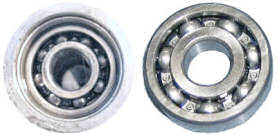
Two main bearings are found inside the snout, one in front near the pulley and one at the rear near the coupler. These are discs containing metal ball bearings which surround the drive shaft, allowing it to spin freely.


The noise associated with worn snout bearings is often described as sounding like marbles rolling around inside the supercharger case, or simply grinding. Placing an automotive stethoscope on the snout or other locations of the supercharger will help determine the source of a noise such as this.

Replacement snout bearings are made by MRC, SKF, and NSK. These bearings are similar in design, MRC is actually owned by SKF. They can be purchased seperately from zzperformance.com, or in value packs with other M90 parts at texasthunderbirds.com.

Front Bearing Part Numbers:
* MRC - #203S
* NSK - # NC6203C3X28
* SKF - #6203

Rear Bearing Numbers:
* MRC - #204S
* NSK - NSKNC6204C3X28
* SKF - #6204


Helpful Instructions on Rebuilding the Snout Assembly

Various people have created instructions to provide guidance when rebuilding the snout assembly. These can be found at the following sites:

Blower Nose Seal and Pulley Replacement
How to replace an M90 snout coupler
Rebuilding your Eaton snout
Supercharger Snout Rebuilding Instructions (These can also be found here)

Repairing the Rotor Assembly

The rotor assembly of the Eaton m90 is very durable under normal conditions, and usually requires far less attention than the snout. However, special conditions can cause various parts of the rotor pack to wear out faster than normal. Increasing blower speed without other supporting modifications is one such instance.

When excessive wear to the rotor pack occurs, there are two options. Either the rotor pack can be replaced as an entire assembly, or an attempt can be made to locate for purchase and replace the individual parts which have worn out.

Rotor Pack Replacement

Replacing a worn rotor pack is easier than rebuilding it. Whole packs can often be found with less trouble than individual repair parts. Also, special tools and the effort required for rebuilding are unecessary.

Over the lifetime of the M90 design, Eaton has upgraded the rotor packs. Those found in XR7s and '89 through '93 Thunderbirds had uncoated rotors. In '94, Eaton started coating rotors with an epoxy resin. In '97, Eaton upgraded the rotor coating for the Grand Prix GTP. The exact material used is debated, but it appears to have superior durability to the epoxy coating found in '94 and '95 Thunderbirds.

The ultimate purpose of these coatings is to allow less space between rotors. Spacing the rotors closer causes them to move more air for the same RPM speed. The same levels of boost can then be achieved at a lower rpm for reduced wear. This also lowers the air temperature exiting the blower, and thus increases efficiency.

Replacement rotor packs can be purchased from various sources. HighSpeedLab offers rebuilt and coated rotor packs for 450 dollars (at the present time). A lower cost alternative is to find a used unit in good condition. Uncoated or coated Supercoupe rotors can be reliably purchased through SCCOA club members, ebay, and other sources.

Coated GTP rotors from 1997 to 2003 can be modified to fit Thunderbird M90 cases relatively easily. Used units in good condition can be purchased from Morad Parts Company. They can also be found from other members in the classifieds of ClubGP.

In addition to buying rotor packs, entire superchargers can sometimes be bought from these same sources for low prices. In this case, the rotor pack could be removed from the supercharger, and the other parts resold or otherwise reused.

Rebuilding the Rotor Pack

In some cases, rebuilding the rotor pack can be more desirable than replacing it. Cost is lower compared to a new or professionally rebuilt unit. Also, quality of the finished unit can be controlled.

These parts are usually needed for rebuilding the rotor pack:
  • Rotor seals - Chicago Rawhide Part# 8522
Located in front of the rotors, these seperate air in the rotor chamber front oil in the snout. When worn out, air passing through the seals will cause vacuum leaks and supercharger oil will be lost.

  • Front rotor bearings - NSK Part#NC6203C3X28
Replacing these bearings requires tedious realignment of the rotors to specs within thousandths of an inch. Fortunately, they also seem to wear less than other parts in the rotor pack. They are found behind the gear plate, in front of the rotors. Similar to the front snout bearing, excessive wear will result in noise, grinding, and increased drag on moving parts.

  • Rear rotor bearings - INA part #FC65477
These are needle bearings which hold the rotors in place at the rear of the rotor case.

  • Case sealant - Permatex (Loctite) part #51813
This can be used to form a seal when reassembling the blower case. When cured, it is chemical, heat, and tearing resistant. It is also easily removed if the case must be reopened.

While new bearings usually include lubrication, this grease has been discussed as an alternative by the Supercoupe community. It is a silicon grease designed for bearings in high speed applications. Additionaly, Husky grease part #00603 can be used.

These links provide more information about the steps involved to rebuild the rotor pack:

Friday, February 10, 2006

Protecting the Interior of your Thunderbird

As a Ford Thunderbird or Mercury Cougar owner, you see your interior more than any other place on your car. A well kept interior improves the atmosphere of your car, allowing you focus on and enjoy the driving experience. Fortunately, keeping your interior like new for years or even decades is easy with modern car care products.

Several major culprits cause damage to our interiors.

  • Sun causes fading and cracking of plastic, vinyl, and other exposed surfaces.
  • Water enters through worn seals or from occupants causing various damage including rot, mold, and rust.
  • Pollutants like dust and smoke residue cause dirt buildup, degradation of soft surfaces, and odor.
  • Spills and debris from occupants such as food or mud can leave tough stains and sticky residue on carpet, upholstery, and just about any other surface.

Over time, the damage caused by these factors becomes irreversible. While restoration to some extent is possible, prevention is always the best cure. These are a few of the companies producing safe and effective products for interiors:
  • 303 Products
  • 3M
  • BTI Chemical (Plexus
  • Meguiar’s Inc
  • Sonus
  • Summit Industries (Lexol)

The following surfaces can be easily and entirely protected with these products:

Carpet & Cloth
303 Cleaner & Spot Remover - Biodegradable colloid cleaner, leaves no residue
EagleOne Zap Spot Remover - Cleans difficult stains of various types
3M Scotchgard - Sealant to repel oil & water based stains

Leather
Lexol ph - Loosens & suspends dirt for better cleaning while maintaining ph balance
Lexol Leather Conditioner - preserves & lubricates without chemical solvents

Plastic
303 aerospace protectant - Complete UV protection (cracking, fading), repels foreign debris, safe and useful on most surfaces
plexus - safely cleans, usable on tint, creates antistatic coating which resists debris, oil, scratches, and yellowing

Vinyl & Rubber
Lexol Vinylex - cleaning, UV protection, restores plasticizers to reduce cracking
Meguiar's #40 - cleaning, UV protection, faded color restoration

While new and useful products are constantly being created, these have earned a significant following among owners of all kinds of cars.

Saturday, January 21, 2006

LED Tail Lights Background & Troubleshooting Information

The tail lights of a Thunderbird have always been among the cars most remarkable characteristics. The Jet turbine look of the original, the full width lights in '66, the futuristic aero lights of the late 1980's, and the eye catching LED tail lights of the Superbirds.

Background on the Thunderbird LED tail lights

Tail lights on '92 through '97 Thunderbirds are unique from other years. Light Emitting Diode circuits designed by Hewlett Packard are responsible for their mesmerizing glow. They are energy efficient, maintenance free, and last as long as 100,000 hours. This was one of the first automotive applications for the LED technology which will soon become status quo.

Repairing dim or burned out tail lights

Each tail lamp contains a circuit board which holds 20 LEDs. These are grouped as 4 individual circuits, 5 LEDs per circuit. Each circuit contains resistors to regulate current.

Over time, moisture can enter worn housings. Circuit boards corrode and resistors fail. When this happens, one or more groups of LEDs go out, leaving a characteristic pattern of dark spots visible throughout the tail light.

A simple solution to this problem is to replace the entire LED strip. Tail lamp housings are cut open, the bad LED strip is removed, and a working one is inserted in its place. Instructions for this can be found at the TCCOA. Sources for LED strips include the SCCOA classifieds, TCCOA classifieds, and ocassionaly eBay.

In the event that replacement LED strips are unavailable it is possible to repair a bad strip. This is a more complex solution and will require some electrical knowledge. The basic process involves diagnosing failed components, finding appropriate replacement parts, and installing them. Relevant technical information can be found on discussion groups at Google, and electrical hobby sites.

The original LED strips created by Hewlett Packard are becoming scarce, and discussions are in progress to replace them. In the future, aftermarket alternatives may be created using parts from various sources.

Replacing the Entire Tail Light

Sometimes replacing the entire tail light assembly is the best option. Doing so eliminates the need to cut housings open, search for hard to find parts, and perform tedious repair work. The only drawback is expense. New lamps cost considerably more than repairing a broken unit, especially if buying more than one.

Currently, new tail lights from Ford are about $100.00 depending upon location. New units can also be found at some online vendors such as Rockauto or Fivestarford. Purchasing tail lights used can help offset cost. These can be found on eBay, TCCOA classifieds, SCCOA classifieds, and similar sources.

Friday, December 16, 2005

Fog light upgrades for better visibility

Many of us find our oem fog lamps to be inadequate. Dim stock bulbs and worn out housings cause limited brightness and range. Fortunately, there is a solution. Stock fog lights can be improved, and we can find aftermarket equipment for a complete upgrade.


Improving the factory fog lights.

Our stock fog light bulbs use about 27 watts of current, and have halogen gas. Swapping to aftermarket alternatives such as the Sylvania SilverStar or GE Nighthawk is the most effective upgrade we can make to factory equipment. These use about 37 watts and contain a small amount of xenon gas mixed in with the halogen. Xenon allows a higher operating temperature for better efficiency. The benefit is a significant improvement in visibility.

Part numbers for various fog bulbs include:

  • Stock bulbs : 880
  • Brighter, higher wattage bulbs: 893
  • Longer life, higher wattage bulbs: 899

When changing the bulbs, check the condition of your fog light housings. As they age, reflectors and lenses deteriorate. Beam control is lost, and less light reaches the road. Because of the big impact this makes on visibility, you should replace fog light assemblies in poor condition. New oem style Thunderbird and Cougar Fog Light assemblies are currently on sale at Partstrain. Other sources include Autozone and Napa.

Part numbers for stock fog light assemblies:

  • Napa Part: BK19536501
  • Autozone part: FO2590106
  • PartsTrain SKU: 19-5365-01
  • '89-'91 Motorcraft (replaced by below): f1sz15200nl
  • '92-'97 Motorcraft: f2sz15200a

The final improvement to the factory fog lights we will discuss involves upgrading stock wiring. This circuit is wired together with the head lights, fog lights, and multifunction switch on the steering column. Over time, heat builds up from the current draw of these devices running together. Failure of one or more switches and a possible fire hazard is the result. View the TSB for this problem at Autorecalls.org. See the SCCOA for a 'how to' article that walks you through an easy solution for this problem.


Upgrading to aftermarket fog lights

Even with improvements, there are situations were factory fog lights simply aren't good enough. This is when upgrading to aftermarket equipment makes sense. The housings have better aim and work with more powerful bulbs. Lenses and optics have lower glare and higher visibility in inclement weather. Separate wiring kits prevent overloaded factory circuits, and allow more flexibility. All these things contribute to a whiter, brighter beam which puts significantly more light where you need it.

Pilot Automotive makes several low cost 55 watt lights similar in size and shape to our stock units. Many Thunderbird and Cougar owners find these useful for adding more brightness while maintaining a stock look. There are many style options including lens color, beam color, beam style (driving or fog), and combined fog/driving lights. Buy these lights at AutoBarn.com or you can find some models at Autozone and other local parts stores.

Part numbers for Pilot fog lights include:

For a significant boost in illumination, the PIAA 1500XT Series are a popular choice for Tbird and Cougar owners. These lamps use polyphenylene sulfide composite (pps) housings and glass lenses for long term durability, and 55 watt h3 bulbs for brightness. PIAA 1500xt light kits are available as fog lights with ion crystal lenses or clear driving lights. Buy them from Autoanything, currently the lowest price for the 1500xt online.

Perhaps the most advanced aftermarket fog light we can upgrade to is the Sylvania Xenarc X1010 HID. The Sylvania Xenarc HID lights produce around 3000 lumens using only 35 watts, with a color temperature as high as 5400k. These can be used as fog lights, or as driving lights with the optional shield removed. Finally, an included wireless remote simplifies installation by replacing wiring through the firewall necessary with other light kits.

Friday, November 18, 2005

M5R2 transmission rebuild & info

Recently I've noticed interest regarding the M5R2 transmission, equipped in Thunderbird SC and '89 - '90 Cougar XR7 packages. This was a 5 speed manual transmission designed by Mazda, hence the name Mazda 5 speed Rear wheel drive 2nd edition. There were approximately 19000 Supercoupe and 3000 XR7 packages with this transmission.

While the basic M5R2 design was shared amongst several Ford vehicles, there were unique differences for the SC and XR7. These were due to the personal luxury status of the cars, and hence it is widely believed some durability was sacraficed for smoother gear selection.

For some owners, this has led to trouble with the synchronizer assemblies. The problem is amplifed by clutch problems and power shifting. A type of plastic fiber backing on the brass blocker rings becomes worn, failing to produce the friction necessary to sync gears. In the process other parts are often damaged, resulting in symptoms like grinding when shifting, hard shifting, and gears disengaging while driving.

There are several things you can do when problems occur. The transmission can be rebuilt using stock or a limited selection of aftermarket parts, it can be replaced with another M5R2, or it can be replaced with a T-5 using the extension kit available from MN12performance.

Numerous informative rebuilding instructions can be found, including the following:
Rebuild kits and parts are available from Southern Gear, Autozone, Napa, and Rockauto. Part numbers listings can be found at the SCCOA.

Sources for new, used, or rebuilt M5R2 transmissions include:
Autozone (Accurate transmissions)
Jasper (part # E9SR-AB)
ebay
Southern Gear
SCCOA Classifieds

Thursday, November 17, 2005

Snow tires improve winter driving

Modern winter tires incorporate extraordinary technology for excellent traction on winter road surfaces. Their unique composition significantly outperforms all season tires for traction on ice, snow, slush, and other winter conditions. Performance winter tires offer a good compromise between traction, handling, and treadwear for those who regularly encounter dry winter roads.

For many in the northern hemisphere, that which make our cars so fun in mild weather can cause difficulty in the Winter. While there are numerous actions you can take to reduce problems from winter roads, perhaps the most beneficial is investing in a set of winter tires. This is especially true for our larger rear drive personal luxury cars.

List of Snow tire brands
See the newest winter tires for 2005 at The Tire Rack

Wednesday, November 16, 2005

Yellow Headlights: Repair & Preventing

Over time, the plastic headlamps on many Thunderbirds and Cougars wear out. Sun exposure and broken seals lead to corroded sockets, worn reflector mirrors, and discolored lenses. The result is dim, ugly headlights which detract from the appearance of your car.

It is possible to improve the appearance of discolored lenses without replacing the entire assembly, although the headlamps can be replaced for a reasonable cost. Replacement is also the only option for damaged reflectors. Sources for new units include eBay and supercoupeperformance. The lenses of new headlamps can be protected from harmful sun exposure by using lens covers, UV protectant wax (303 Aerospace or Zaino), or even sealant.

If moisture has corroded the wiring to your headlamps, you can purchase an upgraded wiring harness from Competition Limited, or from a private party as a used part. The upgraded harness also allows safely increasing the output of our stock lighting system.

Saturday, November 12, 2005

The cost of Gasoline

Gas prices have been a popular topic in recent times, especially among Thunderbird and Cougar drivers. Gas prices throughout the nation can vary widely, and there is much discussion as to the cause.

Take a look at gas prices throughout the nation..

Find the cheapest gas prices at stations in your area..

Learn about some of the factors that influence fuel prices

Here is a wealth of information about the fuel we currently use for our cars

Alternative fuels are becoming increasingly available, and it is interesting to note there are already numerous vehicles which operate on them. Fuel cells providing electricity seem to be the most likely alternative to gasoline, and they may soon replace batteries.

I will be discussing average gas economy and mileage improving tips for our cars in the near future..

Thursday, November 10, 2005

Buying and Selling

As our cars become older, finding them for sale in good condition becomes more difficult. At the same time, they also lose value amongst general car buyers. How can we find good values when purchasing, and get a fair price when it comes time to sell? Continue reading to find out..

When buying any used car, overall condition must be evaluated and weighed against asking price. This includes interior, exterior, and mechanical condition. Common issues to watch for on MN12s and other used cars follow:

Check the Interior for:

  • Fading or Cracking Dashboard, steering wheel, pillars
  • Carpet damage, spills under seats, shoe wear
  • Strong musty odor, especially during HVAC operation
  • Worn seats including adjustment, buttons, upholstery, cushions, air support
  • Unevenly worn pedals indicating possible mistreatment
  • Smoke damage including falling headliner, used ashtrays or lighter, burns, thick film on glass or other smooth surfaces
  • Malfunctioning gauges, moonroof, windows, vanity lights, controls, electric accessories
  • Leakage under dash including clutch and brake fluid near pedals, coolant near floor vents, water

Check the Exterior for:

  • Rust around rocker panels (especially under ground effects of SC), wheel wells, under floor pan, doors, suspension components, spoilers, trunk
  • Signs of accident damage such as repainting, bondo, ill fitting body panels, frame/unibody denting
  • Damaged paint and clearcoat especially bumpers, ground effects, and roof
  • Damaged or missing trim, molding, lamp assemblies (esp LED taillights and yellowing lenses) badging, ground effects, air dam, antenna, windows
  • Wheels damaged or bent from curb rubbing and other abuse
  • Sagging doors due to hinges worn from excessive load bearing

Mechanical condition should be verified by knowledgeable people. If you encounter symptoms you don't understand, it is wise to have qualified personal perform diagnosis. Check for the following:

  • Unusual sounds such as whining, whistling, howling, grinding, rubbing, rattling, knocking, tapping, or anything else which stands out. Listen in all places while car is idling and driving including, underhood, suspension, transmission, exhaust, rear of vehicle, ect
  • Unusual odors such as strong sweet smell, burning, gasoline
  • Uneven engine idle, backfire, or misfire
  • Transmission grinding, slipping, or hesitation while driving or changing gears
  • Clutch engagement near end of pedal travel, excessive pedal play, slipping or revving when shifting/accelerating
  • Excessive engine or shifter movement, indicating possible torn mounts
  • Spongy pedal, whistling, grinding, or shaking when braking, fading or low stopping power
  • Low, dirty, or contaminated fluids especially coolant, oil, and automatic transmission
  • Suspension leaning, excessive bouncing, harsh ride, pulling, poor handling, or dog tracking.
  • Smoke from exhaust or underhood, excluding thin light-colored condensation buildup

Of course most used purchases will have at least some minor issues, and the price you pay should be adjusted accordingly. A common method of pricing vehicles is to determine the fair market value using tools such as the Kelly blue book and points of sale (ebay, autotrader, newspapers) and then deduct the average cost of repairs. Pricing may be influenced by demand for rare models like the Supercoupe. Specialized clubs can offer help in these cases.

When selling your car, several factors should be considered to receive the best price.

  • Level of cosmetic and mechanical maintenance
  • Logs of maintenance, repair, and modification history
  • The type of person buying your car, and where to find them

Ensuring your car is properly maintained, clean inside and out, and in good repair makes a positive impression on potential buyers. Car dealers demonstrate their understanding of this important concept when you visit their used car lots. Also, presenting logs or receipts to help buyers verify your information will build trust.

Knowing about the types of people purchasing vehicles like these and what resources they use will help you reach the largest market for your car. You can then compare and choose from multiple offers to recieve the best results. Along with checking local resources like newspapers and car dealers, there are also many online sources for MN12 Thunderbirds and Cougars:

Wednesday, November 09, 2005

Specifications for '89 through '97 Thunderbirds and Cougars

Many of us would like to know more about our cars. Here is information regarding the various packages, production numbers, and more for MN12 Thunderbirds and Cougars through '97.

Thunderbirds included 4 main packages over the years:

  • Base coupe (produced 1989 - 1992, V6, automatic)
  • Sport (produced 1992 only, v8, automatic)
  • LX (produced all years, V6 until 1991, V6 or V8 after, automatic)
  • Supercoupe (produced 1989 - 1995, supercharged V6, automatic or 5spd manual)

In addition to these there were also 1990 35th anniversary and 1995 40th anniversary trims.

Cougars shared many parts of the MN12 platform, including drivetrain options. Packages included the LS until 1993, the XR7, a 25th anniversary trim in 1992, and a 30th anniversary in '97.

The 3 engine options changed moderately over time. The standard V6 pushrod produced 140 horsepower which increased slightly in later years. The V8 was a 200 hp pushrod until 1994, when it changed to a 205 hp modular motor. The Supercharged V6 pushrod produced 210 hp and 315 ft lbs of torque until 1994 when it was upgraded to 230 hp and 330 ft lbs.

Transmissions were limited to a 4 speed automatic which became the electronically controlled 4R70W in 1994 and the 5 Speed M5R2 developed with Mazda available as an option on the Supercoupe package between 1989 and 1995.

Production numbers are as follows:

1989
3.8L T-Bird: 102,059
3.8L SC: 12,809
3.8L SC 5-speed manuals: 8,041
Cougar (w/XR-7 included): 102,275
Total 1989: 217,143

1990
3.8L T-Bird: 82,636
3.8L SC: 21,966
3.8L SC 5-speed manuals: 6,067
Cougar (w/XR-7): 76,467
XR-7 breakdown, Auto: 4,463 5-Speed: 2,238
35th Anniversary edition: 3,371
Total 1990: 181,069

1991
5.0L T-Bird: 16,232
3.8L T-Bird: 59,543
3.8L SC: 7,039
3.8L SC 5-speed manuals: 1,905
Cougar (w/XR-7): 63,701
XR-7 breakdown, Auto: 4,129 5-speed: 841
Total 1991: 146,515

1992
5.0L T-Bird: 12,562
3.8L T-Bird: 57,119
3.8L SC: 4,212
3.8L SC 5-speed manuals: 1,256
Cougar (w/XR-7): 49,254
Total 1992: 123,147

1993
5.0L T-Bird: 19,587
3.8L T-Bird: 106,234
3.8L SC: 3,891
3.8L SC 5-speed manuals: 1,038
Cougar (w/XR-7): 79,700
Total 1993: 209,412

1994
4.6L T-Bird: 66,657
3.8L T-Bird: 51,056
3.8L SC: 2,647
3.8L SC 5-speed: 722
Cougar: 71,026
Total 1994: 191,386

1995
4.6L T-Bird: 94,155
3.8L T-Bird: 14,927
3.8L SC: 5,741
3.8L SC 5-speed: 574
Cougar: 60,201
Total 1995: 175,024

1996
4.6L T-Bird: 86,522
3.8L T-Bird: 25,780
Cougar: 40,700
Total 1996: 153,002

1997
4.6L T-Bird: 66,320
3.8L T-Bird: 18,956
Cougar: 37,240
Total 1997: 122,516"

More detailed discussion about the Thunderbird from Wikipedia is found below..

1989-1997 "Super Birds"
In 1989, the new, much anticipated Thunderbird model premiered. Classified as the MN-12 (Mid-size North American Project 12), the Thunderbird now had four-wheel independent suspension and a slightly smaller, more aerodynamic body. Engine options fell to only two for 1989 as Ford dropped the V8 option for the new T-bird. The LX model was powered by the 140 hp (104 kW) 3.8 L OHV V6 which many felt was underpowered for the nearly 3800 lb (1725 kg) car. A 210 hp (157 kW) supercharged and intercooled version of the same 3.8 L, available only in the top of the line Thunderbird Super Coupe ("SC"). The Thunderbird SC was Motor Trend's Car of the Year for 1989.

In 1991, the Thunderbird's engine options were finally once again expanded to three, and included once again the popular and begged for 5.0 L OHV V8, rated at 200 hp (149 kW). In 1994, the Thunderbird received some minor exterior and interior styling updates (including cup holders, notable missing on the 89-93 models) as well, but the most dramatic change was the new 205 hp (153 kW) 4.6 L SOHC V8 which replaced the iconic and much loved 5.0. The 4.6 brought with it an updated electronic control system (EEC-V), and an electronically controlled 4R70W transmission. The Super Coupe continued on with the same supercharged V6 as before for but now with 230 hp (172 kW) and 330 ft·lbf (447 N·m) of torque. These increases in output would be short lived however as the Thunderbird Super Coupe was discontinued after the 1995 model year.

In 1996, the Thunderbird received its last styling update. Available in LX (available with V6 OR V8) or Sport (V8 only) trim. Both featured redesigned headlights/taillights, smoother re-styled front/rear fascias, body side cladding, new wheels (15" on LX, and 16" on Sport), and a slight hood bulge, which was necessary to fit the updated 4.6 L engines taller, now composite, intake manifold. V-8 models still made 205 hp, but now made 280 ft·lbf (380 N·m) of torque, up 15 ft·lbf (20 N·m). The 3.8 L V6 continued to make 145 hp and 215 ft·lbf (291 N·m) of torque and was the base engine in the LX. The gear ratio dropped from 3.08 that had been the only ratio offered on the 89-95 to 3.27 giving the big car a bit more grunt out of the stoplight. In 1997, Ford made no changes at all, trying to save as much money as they could on the floundering coupe. As a result, the 1997 Thunderbird's appeal suffered even more, as the only options available were a Power Sunroof, Power driver Seat, Remote Keyless Entry or a CD player. A low drag co-efficient contributed to a impressively consistent 24-28 mpg on the highway even at speeds over 75 mph. The last four-seat Thunderbird rolled off the assembly line in Lorain, Ohio on September 4, 1997.

There was some difficulty in naming the car, with suggestions ranging from the exotic to the ridiculous (Hep Cat, Beaver, Detroiter, Runabout, Arcturus, Savile, El Tigre, and Coronado were submitted among the 5,000 suggestions). One serious suggestion was Whizzer. Crusoe offered a $250 suit to anyone who could come up with a better name.
Stylist Alden "Gib" Giberson submitted Thunderbird as part of a list. Giberson never claimed his prize, settling for a $95 suit and an extra pair of trousers from Saks Fifth Avenue.
According to Palm Springs Life magazine, the car's final name came not from the Native American symbol as one might expect, but from an ultra-exclusive housing tract in what would later be incorporated as Rancho Mirage, California: Thunderbird Heights.

Tuesday, November 08, 2005

Information for all Tbird & Cougar Owners!

As owners of these cars, we all know how difficult it can sometimes be to find help or information. I created this blog to provide information about maintenance, fixing and preventing problems, cosmetic and mechanical modifications, audio/video upgrades, aftermarket resources, and more for our cars.

As a community, we can help each other improve the experience of owning our cars. Feel free to post comments questions, and responses throughout the blog. Communication is one of the best ways to learn!